Beginner Gym Machine Workout: A Simple Full-Body Plan
A beginner gym machine workout should be a simple full-body routine you run two or three days a week: a leg press, a chest press, a seated row, a lat pulldown, a hamstring curl, and one core hold or carry. Use light weights, 2 to 3 sets of 8 to 12 reps, and add weight only once every rep feels clean. Machines are a smart first step because they take away the setup and balancing that free weights demand, so your first month goes into learning effort, form, and how to track a session instead of fighting the equipment.
If you have walked into a gym, done a few random machines, and left unsure whether any of it added up, this guide is for you. The plan below tells you which machines to use, in what order, how many sets and reps, and how to make the weights go up over time. Nothing here needs a barbell or a spotter, and you can start it on your next visit.
What should a beginner do at the gym?
The honest answer to what to do at the gym as a beginner is less than you would guess. You do not need fourteen exercises or a different session every day. You need one movement for each thing your body is built to do, done on equipment you can set up in seconds, repeated until it feels normal.
There are five basic patterns, and machines give you a clean version of each:
- Push something away from you (chest press).
- Pull something toward you (seated row).
- Pull something down from overhead (lat pulldown).
- Press with your legs (leg press).
- Bend at the hips and knees to work the back of your legs (hamstring curl).
Add one core exercise and that is a complete, balanced session. The reason machines suit a beginner is not that they are easy. It is that they hold the path of the movement for you, so you can push hard and still learn what a good rep feels like before you take on the extra job of balancing a free weight.
Why start with machines instead of free weights?
Plenty of new lifters avoid the dumbbells and barbells entirely, worried about dropping something or getting the form wrong and hurting themselves. That instinct is reasonable, and machines answer it directly. The seat and the guide rails remove most of the balance and setup, so the only thing left to learn is how to push and pull with control.
That smaller job matters in your first month. You are trying to build three habits at once: showing up, working at a sensible effort, and writing down what you did. A machine lets you spend your attention there instead of on keeping a bar from tipping. When those habits are steady, free weights stop feeling intimidating, and adding a pair of dumbbells is a small step rather than a leap. If you want the fuller picture of that first month, our guide to beginner strength training in your first four weeks walks through it week by week.
The beginner gym machine workout routine
Here is the full-body machine workout routine to start with. Do the exercises in this order, rest 60 to 90 seconds between sets, and keep the weight light enough that the last rep of each set is controlled, not a struggle.
| Order | Machine | What it trains | Sets × reps |
|---|---|---|---|
| 1 | Leg press | Legs and glutes | 2–3 × 8–12 |
| 2 | Chest press | Chest, shoulders, triceps | 2–3 × 8–12 |
| 3 | Seated row | Upper back and biceps | 2–3 × 8–12 |
| 4 | Lat pulldown | Lats and upper back | 2–3 × 8–12 |
| 5 | Seated hamstring curl | Back of the legs | 2–3 × 8–12 |
| 6 | Suitcase carry or plank | Core and grip | 2–3 × 30–40 sec |
Six exercises, two or three sets each, is roughly 35 to 45 minutes including rest. Start with two sets while you learn the machines, then add the third set once the sessions feel routine. Do not chase soreness or a burn. The job of this routine is to be repeatable, and a session you can walk out of feeling worked but fine is one you will come back to.
How to set up each machine
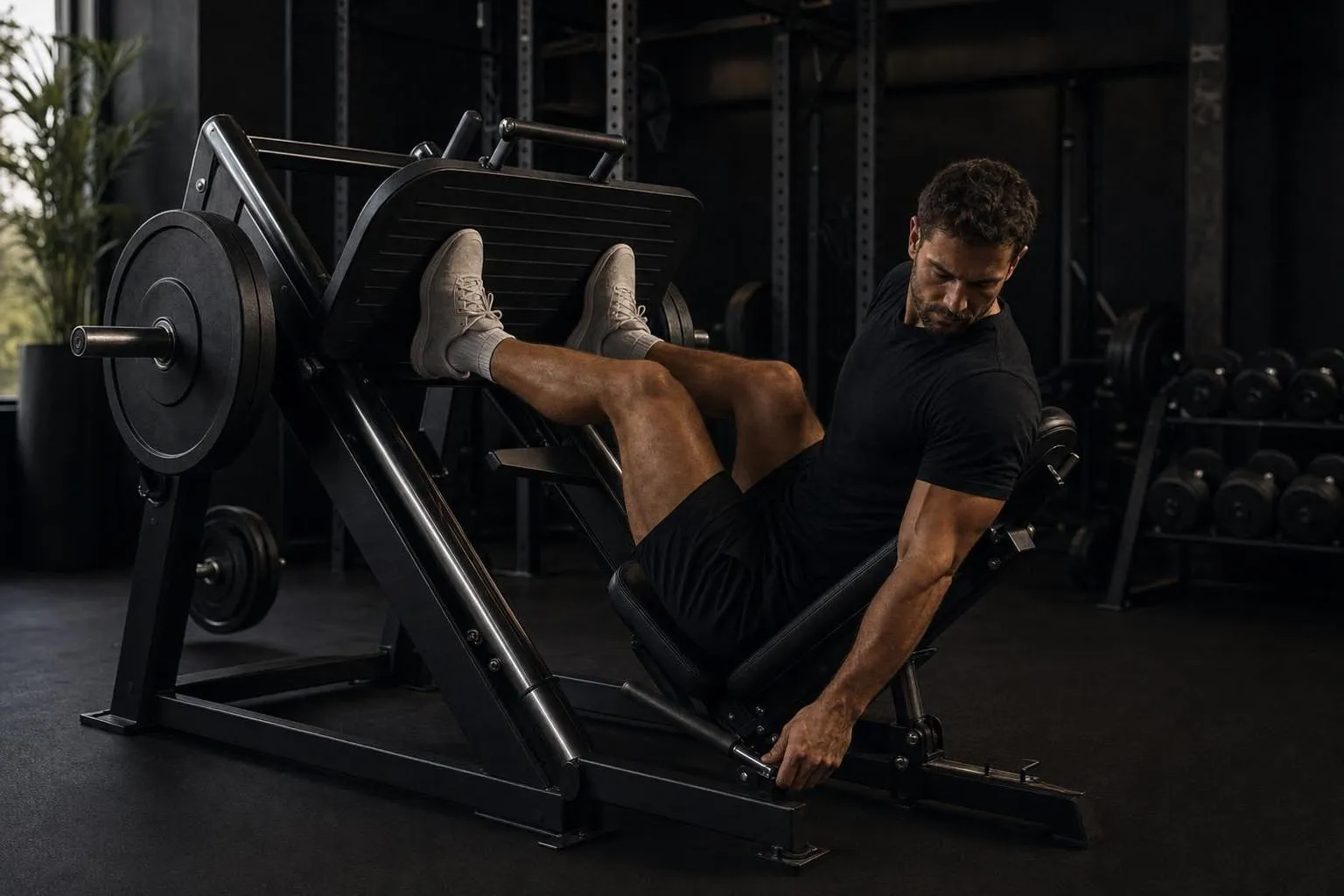
The single skill that makes machines work is the setup. Two minutes spent adjusting the seat is the difference between a movement that trains the right muscle and one that just feels awkward. A few cues per machine:
- Leg press. Set the seat so your knees start at about a right angle, feet flat and shoulder-width on the platform. Push until your legs are almost straight, but do not lock the knees hard at the top. Let the weight come back until your knees are near your chest, no further.
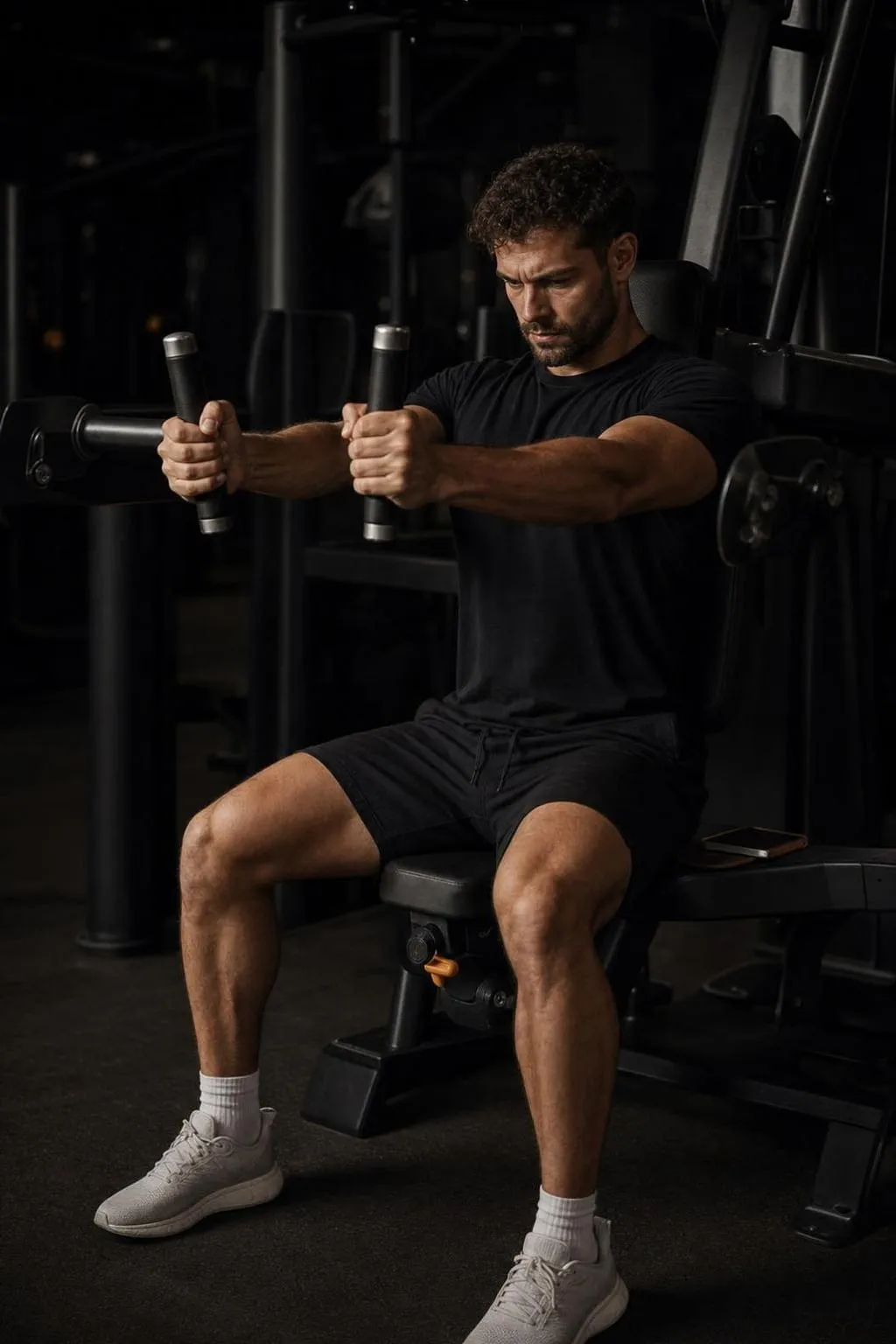
- Chest press. Adjust the seat so the handles sit at mid-chest height. Grip both handles, keep your wrists in line with your forearms, and press forward until your arms are nearly straight, then return under control.
- Seated row. Sit tall, chest against the pad if there is one, and pull the handles to your stomach by driving your elbows back. Squeeze for a beat, then let the weight stretch your shoulder blades forward before the next rep.
- Lat pulldown. Pin the thigh pad so you stay seated, take a grip a little wider than your shoulders, and pull the bar to your upper chest while keeping your torso mostly upright. Do not yank it behind your neck.
- Hamstring curl. Line the pad up just above your heels, and curl by bending your knees, not by rocking your hips.
For every machine, run the first set light on purpose. Treat it as a form check and a chance to confirm the seat is right. If a movement pinches or feels wrong in a joint, stop, lower the weight, and check the setup before you push on.
How many days? A workout split for beginners
The best workout split for beginners is barely a split at all: the same full-body session, two or three times a week, with a rest day in between. You do not need to divide the body into separate days yet, because you are only doing one exercise per muscle group, and hitting each one a few times a week is exactly what drives early progress.
A 3 day workout split for beginners can be as simple as running the routine above on Monday, Wednesday, and Friday. Every session is the same six machines. That repetition is a feature, not a lack of imagination. Doing the same movements often is how they stop feeling foreign and start feeling automatic, and it makes progress easy to see because you are always comparing like with like.
The 2026 American College of Sports Medicine position stand found that strength improved more with at least two sessions a week, and that equipment type did not consistently change results, so machines are a fair place to start (ACSM, 2026). If your week doesn’t fit that pattern, the free beginner workout split chooser has a machines-only option that maps your available days to a starter schedule.
Save the fancier splits (upper and lower days, push-pull-legs) for later, when you have more exercises and enough training history to fill them. For a deeper look at choosing days and building a plan that survives busy weeks, see our strength training planner guide, which covers machine-based beginner routines and how to adjust them.
How to progress so you keep getting stronger
A routine only works if it gets harder over time. Your body adapts to what you ask of it, so if the weight never changes, neither will you after the first few weeks. The fix is progressive overload: asking for a little more, on purpose, once you have earned it.
On machines the rule is simple. Earn the reps first, then add the weight:
- Pick a rep range, say 8 to 12.
- Keep the same weight until you can hit the top of the range, 12 reps, on every set with clean form.
- Then move the pin up one plate. Your reps will drop back toward 8, which is exactly right.
- Build back up to 12, and repeat.
That is the whole engine. As a beginner you can often add weight every week or two on the bigger movements like the leg press, and a little slower on smaller ones. Write down what you lift every session, because six weeks in, the only way to know whether today should be the same weight or the next plate up is the record of what last week felt like.
Common beginner mistakes on machines
A few things trip up almost everyone at the start:
- Wandering between random machines. Picking whatever is free with no order or record is the fastest way to train for months and go nowhere. A fixed routine you repeat beats a new set of machines every visit.
- Skipping the seat adjustment. Using a machine on someone else’s settings is the most common reason a movement feels wrong. Set the seat every time, even when it costs you a minute.
- Going too heavy too soon. If your form falls apart on the last few reps, the weight is teaching you bad habits, not building strength. Lighter and controlled wins.
- Never writing anything down. Progress needs a memory. A note of the machine, the weight, and the reps turns guessing into a plan.
- Quitting during a slow week. You will miss sessions. Shift the week forward and carry on rather than restarting from zero.
Let the app choose your next machine
Everything above is a plan you can run by hand: pick the machines, set the seats, track the weights, and nudge the load up when you have earned it. If you would rather not research a routine on the gym floor or keep the log yourself, that is exactly what Fit Trainer is built to do.
Tell it you are new and where you are training, and it builds a simple machine-based session, explains each movement with images and step-by-step cues, guides you set by set, and remembers what you lifted so it can pick the next weight for you. When you want to swap a machine that is taken or move past machines entirely, you just ask in the chat. Here is how it works as a beginner workout app that tells you exactly what to do, and as a progressive overload app once you are ready to add weight on purpose.
Frequently asked questions
What machines should a beginner use at the gym?
Start with one machine per major movement: a leg press for your legs, a chest press for pushing, a seated row and a lat pulldown for pulling, a hamstring curl for the back of your legs, and a core hold or carry. Six machines cover the whole body, and every one is easy to set up and hard to do badly.
Is a machine-only workout enough for a beginner?
Yes. For your first few months, a full-body machine routine builds real strength and teaches you how each movement should feel, with far less setup and balance to manage than free weights. Machines are a starting point, not a cage: once the movements feel natural you can add dumbbells whenever you want.
How many days a week should a beginner train on machines?
Two or three days a week, with a rest day between sessions. A 3 day workout split for beginners can simply be the same full-body machine routine done Monday, Wednesday, and Friday. Three sessions you actually keep beat five you abandon by week three.
When should I add weight on a machine?
Add weight only when you can finish every set at the top of your rep range with clean, controlled form. If you are aiming for 8 to 12 reps and you hit 12 on all your sets, move the pin up one plate next time and let the reps drop back toward 8. If form breaks down, stay where you are another week.
Sources
- Currier BS, D’Souza AC, Singh MAF, et al. American College of Sports Medicine position stand. Resistance training prescription for muscle function, hypertrophy, and physical performance in healthy adults: an overview of reviews. Medicine & Science in Sports & Exercise, 2026;58(4):851–872. This updates the 2009 ACSM position stand.