Bodyweight Workout Plan: No Equipment Needed
A useful bodyweight workout plan with no equipment is a full-body routine built around a squat or lunge, a push, a hip hinge or glute movement, a safe back-focused alternative, and core work, repeated two or three nonconsecutive days per week. Beginners should choose controlled variations, leave room to recover, and progress with clean reps, range of motion, tempo, or a harder variation instead of changing routines every day. Pain, rehabilitation, and medically limited movement need guidance from a qualified clinician or exercise professional.
What makes a no-equipment plan complete?
A list of exercises is not yet a plan. A usable session tells you which movement comes first, how many sets to do, where to stop each set, how long to rest, and what changes next time. That structure matters when the gym closes, a trip leaves you in a small room, or you want a workout at home with no equipment and do not know how to connect individual movements.
Recent Reddit discussions show the same planning gap from several angles. One beginner asked for a calisthenics workout without equipment, another wanted an app to turn home constraints into a workout plan, and home trainees compared how they exercise without equipment. These are market examples, not evidence that any product produces a particular result. The useful signal is the question itself: beginners want a coherent routine and a way to progress it.
The current American College of Sports Medicine resistance training position stand recommends progressive resistance training for healthy adults and found that equipment type did not consistently change training outcomes. The CDC adult activity guidance recommends muscle-strengthening activity for all major muscle groups on at least two days each week. This plan turns those broad principles into a conservative starting session for a healthy beginner.
What is the full bodyweight workout plan?
Use this same session for your first two or three weeks. It takes about 30–40 minutes when you do two work sets per movement. Keep every repetition controlled and stop each set while you could still complete about two clean reps. The target is repeatable practice, not an all-out test.
Start with a five-minute warm-up:
- March in place for 60 seconds. Let your arms swing and gradually increase the pace.
- Practice six slow hip hinges. Keep soft knees, push your hips back, and stand tall again.
- Do six alternating reverse lunges per side. Use a wall lightly for balance if needed and shorten the range.
- Do six wall push-ups. Keep a straight line from head to heels and move smoothly.
- Do six dead bugs per side. Move one opposite arm and leg while keeping your lower back comfortably supported by the floor.
Then complete the main session in this order:
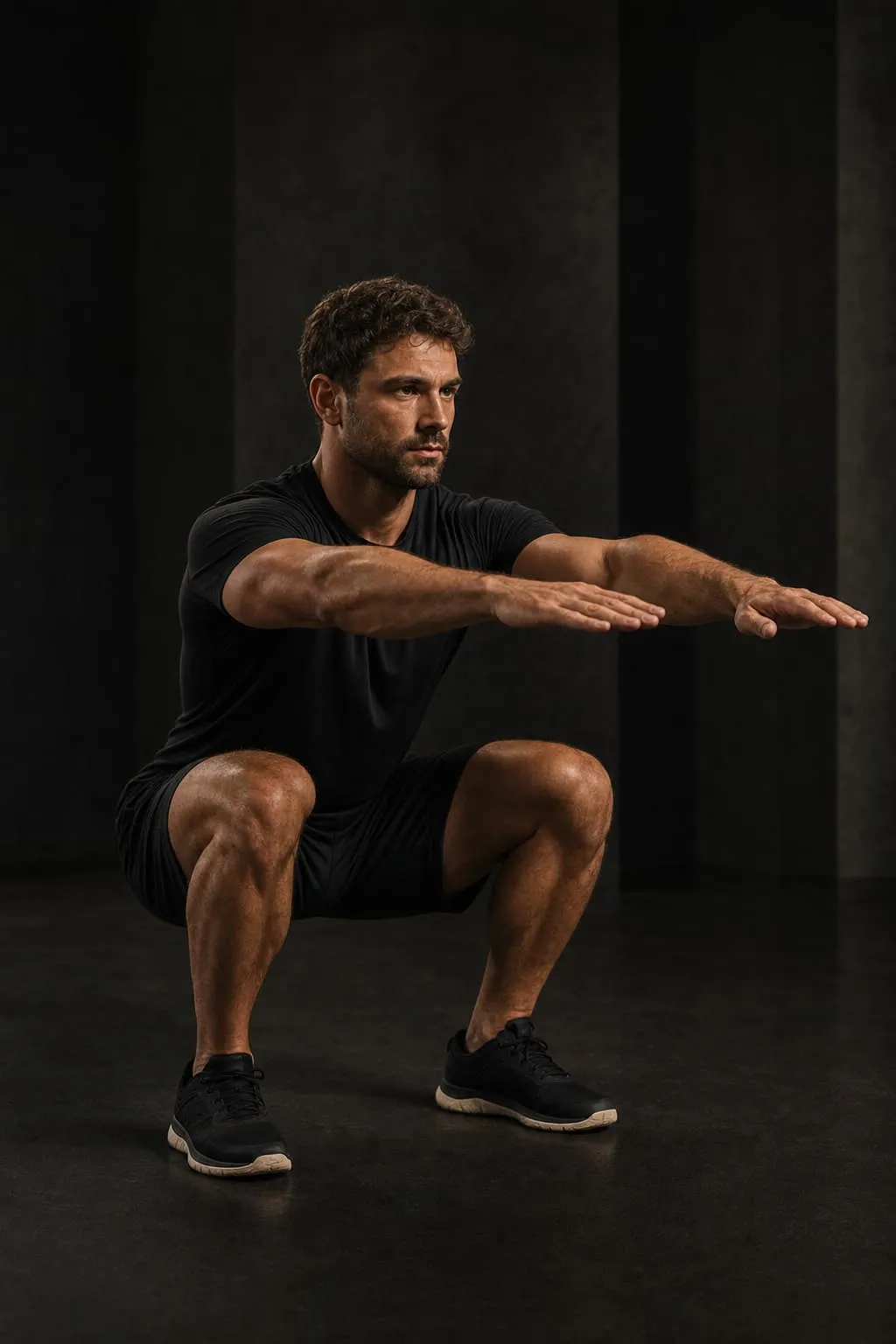
- Bodyweight squat: 2 sets of 8–12 reps, rest 60–90 seconds. Sit between your hips with your feet flat and knees following the direction of your toes. Regress to a sit-to-stand from a stable chair. Progress with a one-second pause at the bottom before you add a harder variation.
- Push-up: 2 sets of 6–10 reps, rest 90 seconds. Use the wall if the floor version is too hard. A lower hand position makes the movement harder, so progress from wall to a stable counter and then to the floor. Keep elbows at a comfortable angle rather than flaring them straight sideways.
- Reverse lunge: 2 sets of 6–10 reps per side, rest 60–90 seconds. Step back far enough that the front foot stays flat. Use fingertip support on a wall or do a stationary split squat if balance limits the movement.
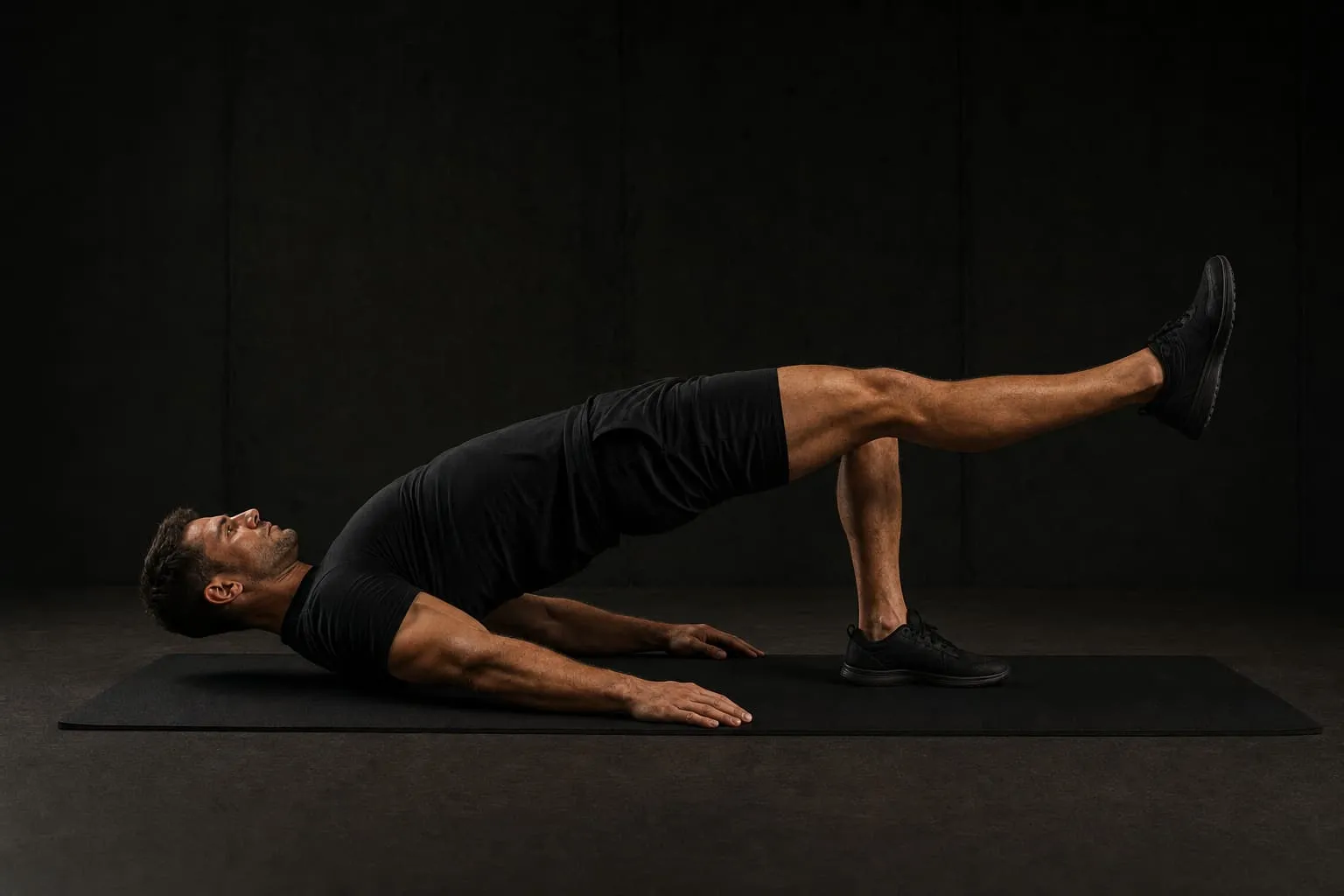
- Glute bridge: 2 sets of 10–15 reps, rest 60–90 seconds. Start with both feet planted and lift until your hips are level with your torso. Pause at the top without forcing your lower back. Progress to a single-leg bridge only when you can keep the pelvis level.
- Prone W raise: 2 sets of 8–12 reps, rest 45–60 seconds. Lie face down, bend your elbows into a W, and gently lift your hands and elbows while drawing the shoulder blades back. Keep the movement small and your neck neutral. This gives the upper back some work, but it does not replace a loaded pull.
- Dead bug: 2 sets of 6–10 reps per side, rest 45–60 seconds. Exhale as the opposite arm and leg extend. Shorten the reach if your lower back lifts or the movement becomes rushed.
The search phrase home workout plan no equipment is shorthand for this kind of complete session, but the exact numbers are still starting targets. If the first set falls below the minimum with controlled form, use the listed regression. If you pass the top of the range easily, slow the lowering phase before moving to a harder exercise.
How should a beginner choose the right variation?
Choose the version that lets you control the entire repetition and finish with roughly two clean reps still available. A variation is too hard when the range shortens unexpectedly, your position changes to finish the rep, or you cannot reach the bottom of the target range. Move one step easier for the remaining sets.
Use simple ladders instead of random exercise changes:
- Squat: sit-to-stand, bodyweight squat, pause squat, then split squat with a longer range.
- Push: wall push-up, stable-counter push-up, knee push-up, then full floor push-up.
- Glutes: two-leg bridge, paused bridge, marching bridge, then single-leg bridge.
- Core: short-range dead bug, full dead bug, then a longer lever with the leg closer to the floor.
- Upper back: prone W raise, longer-range reverse snow angel, then a real row once safe equipment is available.
Change the variation only when the current step is clearly too easy or too hard. Repeating the same movements gives you something useful to compare next session.
How many days per week should you train?
Start with two nonconsecutive full-body days. Monday and Thursday works, as does Tuesday and Saturday. The CDC minimum of two weekly muscle-strengthening days is a clear starting point, and ACSM’s 2026 guidance for healthy adults emphasizes training the major muscle groups at least twice per week over chasing a complicated routine.
A simple two-day week looks like this:
- Monday: full plan.
- Tuesday and Wednesday: rest from strength work. Walking and easy mobility are optional.
- Thursday: full plan.
- Friday through Sunday: rest from the plan, with normal daily activity as comfortable.
If two days feel manageable for two or three weeks, you can use a Monday, Wednesday, Friday schedule. Keep at least one day between sessions and use the same exercise versions. On the third day, stay with two sets rather than adding more work everywhere. If soreness changes how you move, sleep is disrupted, or repetitions are less controlled than the prior session, keep the two-day schedule or take another rest day.
How do you progress bodyweight exercises?
Use one progression rule for the whole plan: when every set reaches the top of its rep range with controlled form and about two clean reps left in two consecutive sessions, change one difficulty lever. Add a little range of motion, use a three-second lowering phase, add a pause at the hardest position, or move to the next variation in the ladder. Do not change all four at once.
For example, begin squats at 2 sets of 8. Add a rep when the current target stays controlled. After you complete 12 and 12 in two sessions, keep the reps at 8–10 and add a pause, or move to a split squat. For push-ups, reach 10 and 10 at one hand height before lowering your hands to the next stable surface. The same approach is explained in the guide to progressive overload without guesswork.
Write down the variation, reps, and sets after each session. The log only needs to answer one question next time: should you repeat, add a clean rep, or move one step harder?
If you want today’s session rebuilt around your actual room, time, and logged sets, try the Fit Trainer no-equipment workout app or open Fit Trainer. It can capture the current setting and available equipment, guide the workout, record each set, swap a movement mid-session, and rebalance the remaining targets from what you log.
What can replace a pulling exercise with no equipment?
A true pulling pattern is difficult without a safe anchor, bar, band, cable, or weight. A prone W raise or reverse snow angel can move the shoulder blades and train the upper back lightly, but neither creates the same resistance as a row or pull-up. Describe it as back-focused work, not as a complete pulling substitute.
Do not hang from a door, wedge a towel into a door, crawl under a household table, or rely on furniture that was not designed to support training force. Those setups can shift, tip, or fail. The safest no-equipment choice is to keep the prone upper-back movement in today’s session and restore a real pull when suitable equipment becomes available.
If you gain access to a resistance band, dumbbell, cable, or fixed pull-up bar, choose a movement from the pull-up alternatives guide. Travelling with a limited dumbbell rack instead of an empty room? Use the hotel gym dumbbell workout so the session includes a loaded row.
How can Fit Trainer adapt a no-equipment session?
An at home workout no equipment request can still change from one day to the next. The room may be smaller, a push-up variation may be too hard after the first set, or the planned 40 minutes may shrink to 25. The same is true when a workout at home no equipment day replaces a gym session. A static calisthenics workout plan no equipment document cannot see that context.
Fit Trainer starts from the equipment, location, available time, and session context you provide. It creates a guided workout, lets you request an exercise swap during the session, logs completed sets, and can rebalance the work that remains after you record performance. The product screen below is a real Fit Trainer set-logging view, not a generated interface.
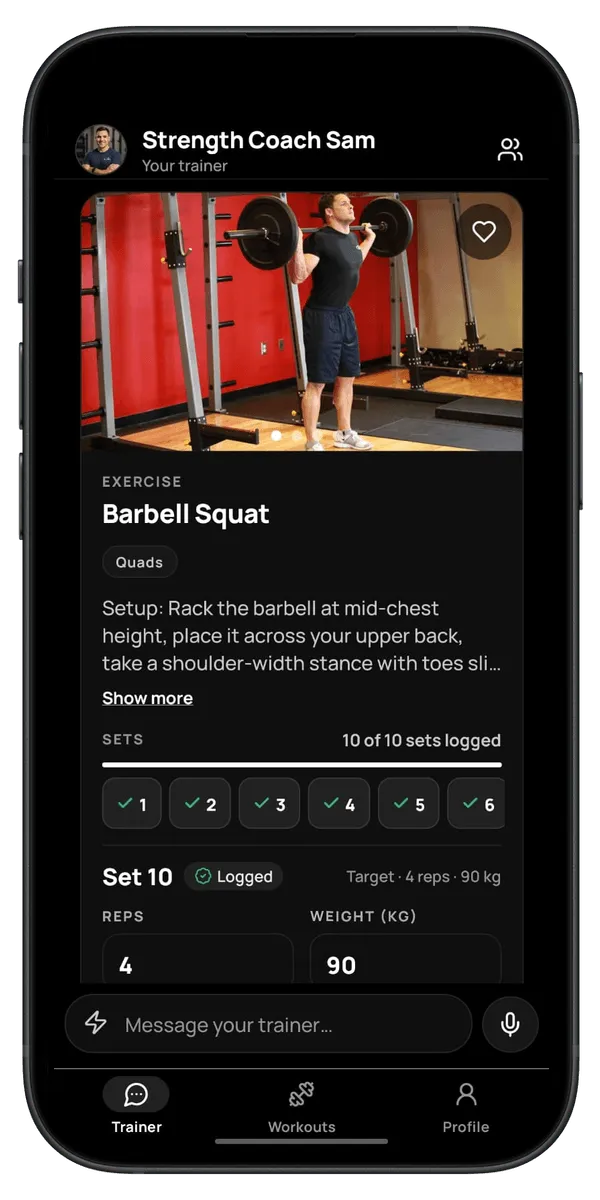
The app does not assess pain or provide rehabilitation. Use it to organize general fitness training within movements that are already appropriate for you.
When should you stop or get qualified guidance?
Stop a movement if you feel sharp, worsening, or unfamiliar pain, or if a symptom changes your normal movement. Do not use a general no equipment workout plan to work around an injury, a rehabilitation restriction, dizziness, chest pain, or another medical limitation. A qualified clinician can assess symptoms, and an appropriately credentialed exercise professional can help choose movements for your individual situation.
Ordinary muscular effort and medical warning signs are not the same, but an article cannot evaluate what you are feeling. When you are unsure, pause the session and seek personal guidance.
What are common no-equipment workout questions?
How many days per week should a beginner do bodyweight training?
Start with two full-body sessions on nonconsecutive days. If you recover comfortably and your reps stay controlled, a third nonconsecutive session can fit. Keep at least one rest day between sessions at first.
How do you progress bodyweight exercises without weights?
First add clean reps within the exercise range. When you reach the top of the range for every set in two sessions, add range of motion, use a three-second lowering phase, or choose the next harder variation. Change one factor at a time.
What can replace a pulling exercise with no equipment?
A prone W raise or reverse snow angel can give the upper back useful movement, but neither is a true pulling replacement. Without a safe anchor, bar, band, or weight, loaded pulling is difficult. Do not improvise rows from doors, tables, or unstable furniture.
Can I do this workout in a small room?
Yes. The plan needs enough floor space to lie down and extend your arms and legs. Use a wall for push-up or balance regressions, and keep the area clear so each repetition has a controlled path.
Return to the Fit Trainer Journal for more training guides and exercise substitutions.
Sources
- Currier BS, D’Souza AC, Singh MAF, et al. American College of Sports Medicine position stand. Resistance training prescription for muscle function, hypertrophy, and physical performance in healthy adults: an overview of reviews. Medicine & Science in Sports & Exercise, 2026;58(4):851–872.
- Centers for Disease Control and Prevention. Adult activity: an overview.