No Muscle Soreness After Workout: Is It Working?
No muscle soreness after workout does not mean the session was ineffective. DOMS varies with exercise novelty, total work, range of motion, and individual response, and it often decreases as your body adapts to a familiar program. Judge the session by controlled form, completed reps and load, how close clean reps came to technical failure, recovery, and progress across repeated sessions; sharp pain is a reason to stop, not positive training feedback.
How do you know if you are training hard enough?
If you searched “how to know if training hard enough,” start with six checks that tell you more than next-day tenderness:
- Form quality. The last clean rep should still look like the exercise you started. A slower rep can be honest effort. A shortened range, swinging torso, or changed joint position means the useful set has ended.
- Planned reps and load. Compare what you completed with what the workout asked for. A written target gives you evidence; a vague memory does not.
- Proximity to technical failure. At the end of a hard working set, estimate how many more clean reps you could have done. Technical failure is the point where the next rep would require a form change, not the point where any movement becomes impossible.
- Repeatable performance. One unusually good or bad set is noisy. Look at the same movement across several sessions before deciding that the plan is too easy or too hard.
- Recovery. Notice whether normal movement and your next planned session are available to you. Recovery is context for the next target, not a contest to feel as little or as much as possible.
- Gradual progression. Over time, one more clean rep, a small practical load increase, or steadier form at the same target can justify the next step. Our guide to progressive overload explains how those small changes add up.
If you want the remaining set targets adjusted from what you actually log, see how the progressive overload app works or try Fit Trainer. Fit Trainer compares target and actual sets and can rebalance the work that remains using increments from your real equipment.
What is DOMS, and why does it fade?
Delayed-onset muscle soreness, or DOMS, is the tenderness and stiffness that can appear after a training session rather than during it. The American College of Sports Medicine explains that unaccustomed loading can produce DOMS and that it often becomes most noticeable 24–72 hours later.
Novelty matters. Your first week back after a long break introduces movements, volume, and ranges of motion your body has not handled recently. Exercises with a demanding lowering phase or work at longer muscle lengths may also create more soreness. Change several of those variables at once and the response can be stronger, even if the weights are modest.
Then the same program becomes familiar. Research on the repeated-bout effect shows that a prior exposure can reduce soreness and other signs of exercise-induced muscle damage during a later similar bout. A systematic review and meta-analysis in Sports Medicine found lower DOMS after pre-conditioning activity in previously untrained participants. Less soreness after a few weeks can therefore reflect adaptation to the task rather than a workout that suddenly stopped counting.
People also respond differently. Two lifters can complete similar work and report different tenderness the next day. That is why your log and your repeatable technique are more useful than comparing soreness with a training partner.
Does no soreness mean no muscle growth?
No soreness does not establish that muscle growth is absent, just as strong soreness does not prove that growth occurred. DOMS is a short-term sensation influenced by novelty and the details of a session. Muscle growth is assessed over longer periods, so a single morning-after feeling cannot measure it.
Avoid replacing one unreliable shortcut with another. Sweat, exhaustion, and a dramatic muscle burn can describe how a session felt without telling you whether the planned work progressed. For an average returning beginner, the practical question is whether you can repeat the movement with control, apply enough effort, recover, and gradually do more across sessions.
If you need a simple baseline for those first sessions, the beginner strength training first four weeks guide keeps the exercise list and progression decisions manageable. The Fit Trainer Journal also collects training guides for common disruptions such as missed time and limited equipment.
Should every working set reach failure?
No. Every working set does not need to continue until you cannot complete another repetition. The 2026 ACSM position stand on resistance training reviewed evidence across healthy adults and found that training to momentary muscle failure did not consistently change hypertrophy compared with stopping before failure. A separate systematic review and meta-analysis likewise found no evidence that momentary failure was superior to non-failure training for hypertrophy.
That does not mean effort is irrelevant. A set can be demanding while leaving one or two clean reps available. For a returning beginner, that buffer can make it easier to keep the intended range of motion and judge technique. Some programs deliberately use failure in selected sets, but it is a tool, not a pass or fail test for every set.
Use technical failure as the boundary. When the next rep requires momentum, a shortened range, or a different joint position, stop and record the clean reps. Do not turn an eight-rep target into eleven altered reps simply because soreness feels reassuring afterward.
When should you hold steady, add a rep, or add load?
Hold steady when you completed the target but the last clean reps were slow, form was only just stable, or recovery was worse than usual. Repeating a target gives you another data point and can confirm whether the hard session was a pattern or an isolated day.
Add one rep when the load is appropriate, every planned rep stayed controlled, and you finished with a little clean reserve. Add it to one set rather than rewriting the whole session. Small rep increases are useful when the next dumbbell or plate jump is too large.
Add load when you reach the top of the planned rep range across the working sets with consistent form. Use the smallest increment you can actually load. After the increase, expect reps to drop within the planned range while you adapt to the new target.
Reduce the target when clean reps fall well short, technique changes early, or your current recovery does not support the planned work. Lower the remaining reps or use the previous load. This is an adjustment to the evidence from that session, not a diagnosis of why performance changed.
What should you do when strength drops during a workout?
If your question is “what to do when strength drops during workout,” stop the set when the intended form is no longer available. Rest for the planned interval, then decide whether the next set needs fewer reps, less load, or the same target with a stricter stopping point. Log the actual result instead of entering the number you hoped to complete.
Often the planned progression reaches a point where presses and raises turn into altered reps. The useful response is to preserve the exercise and adjust the target, rather than count movement produced by cheating the weight up.
A sudden drop can happen within an ordinary session because earlier sets created fatigue. Sleep, food, stress, a recent break, and shorter rest can also affect performance. One session is not enough to identify a trend. If the drop repeats across sessions, review the recent log and hold or reduce the target before adding more.
What if progressive overload form breaks down?
Progressive overload form breaks down when the target increases faster than your ability to perform the intended movement. Keep the clean range of motion and reduce the variable that caused the change. That could mean one fewer rep, the previous load, or a longer planned rest interval.
Do not prescribe yourself through sharp or unusual pain. End the exercise when pain changes the way you move. If pain is severe, persistent, associated with swelling or weakness, or otherwise concerns you, seek help from a qualified medical professional. General muscle-pain guidance from Mayo Clinic also distinguishes minor exercise-related soreness from symptoms that need medical attention.
The next effective action may be smaller than the plan expected. That is still a decision grounded in the session you actually performed.
How can Fit Trainer adjust the rest of a session?
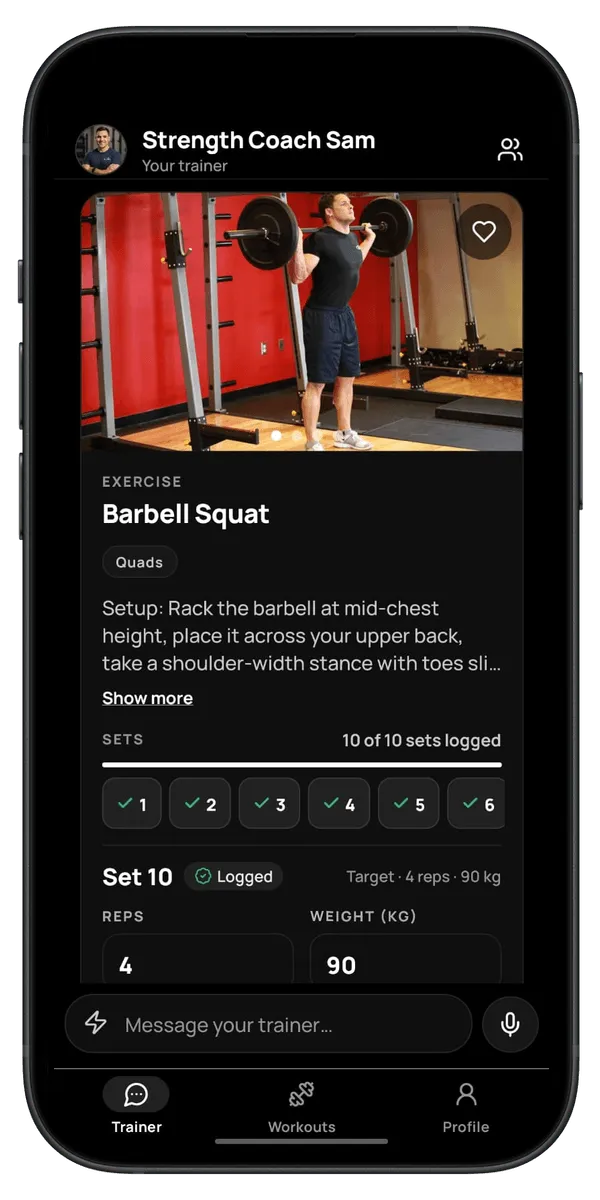
Fit Trainer records the target and actual load and reps for each set. When your logged performance changes, it can rebalance the remaining targets instead of asking you to finish numbers that no longer fit the session.
Those changes use increments from the equipment you actually have. The decision still comes from your performance, while the app keeps the next workable target attached to the workout.
What else should you know about workout soreness?
Does no soreness mean no muscle growth?
No. Soreness is an inconsistent response to training, not a direct score for muscle growth. Track clean reps, load, effort, recovery, and performance across several sessions instead.
Not sore after workout, am I training hard enough?
You may be. If your working sets use controlled form, finish near technical failure when the program calls for hard work, and your logged performance holds or gradually improves, absent soreness alone is not a reason to add more.
Should I add weight if I am not sore?
Do not add weight just to create soreness. Add the smallest practical load only when you complete the planned reps with stable form and enough reserve to make the increase reasonable; otherwise add a rep or hold the target.
What should I do if progressive overload form breaks down?
End the set when you cannot complete another planned rep with the intended technique. Reduce the remaining reps or load, record what happened, and seek qualified help if pain is sharp, unusual, severe, or persistent.
Sources
- American College of Sports Medicine. Delayed onset muscle soreness (DOMS). ACSM Consumer Information Committee brochure.
- Boyd L, Deakin GB, Devantier-Thomas B, Singh U, et al. The effects of pre-conditioning on exercise-induced muscle damage: a systematic review and meta-analysis. Sports Medicine, 2023;53(8):1537–1557.
- Currier BS, D’Souza AC, Singh MAF, et al. American College of Sports Medicine position stand. Resistance training prescription for muscle function, hypertrophy, and physical performance in healthy adults: an overview of reviews. Medicine & Science in Sports & Exercise, 2026;58(4):851–872.
- Refalo MC, Helms ER, Trexler ET, et al. Influence of resistance training proximity-to-failure on skeletal muscle hypertrophy: a systematic review with meta-analysis. Sports Medicine, 2023;53(3):649–665.
- Mayo Clinic. Muscle pain: when to see a doctor.